Harvest Season for SLUB: From io_uring Vulnerability to Novel Sheaf-Based Exploitation Techniques
Authors: Hao-Yu Yang (naup96321), Yu-Ting Lin (ddd_dong)
Preface
This research started with two vulnerabilities I discovered in io_uring. I will first introduce these two vulnerabilities. Then, I will describe my attempt to develop a local privilege escalation exploit for the second vulnerability. During the exploitation process, I encountered several unexpected failures caused by the new SLUB sheaf mechanism. This experience led me to investigate the mechanism further, where I discovered a new attack surface and developed several novel exploitation techniques. : )
Also thanks @ddd-dong give me some idea
1. Background
1.1 io_uring Overview
io_uring is a kernel core component for high-performance asynchronous I/O operations, first introduced in Linux kernel 5.1. It primarily addresses two problems: the performance bottleneck caused by synchronous blocking in traditional I/O operations, and the cost of numerous system calls. io_uring also provides a broad async I/O interface, covering file systems, sockets, polling, and more.

io_uring achieves this by constructing a Submission Queue (SQ) and a Completion Queue (CQ) in shared memory between the kernel and user space. An application in user space packs each required I/O operation into a Submission Queue Entry (SQE) and places it into the SQ. The kernel then reads the SQE and performs the corresponding operation. Once the operation is complete, the kernel writes the result to the Completion Queue Entry (CQE), which is then read by the application in user space. This design improves performance by avoiding a system call for most I/O operations.
In addition, io_uring encourages processing multiple SQEs at once. An application can submit multiple requests to the SQ in a single batch, and the kernel can likewise fill multiple completion events into the CQ at once. There are two ways to trigger the kernel to process the I/O requests in the SQ:
- The
io_uring_entersystem call notifies the kernel to process the I/O requests currently in the SQ. - With
SQPOLL, the kernel starts aniou-sqpthread to poll the SQ, so that some I/O operations can be submitted to the kernel without the application issuing another system call, further improving efficiency.
Unlike traditional epoll, which mainly notifies an application whether a file descriptor is ready for an operation (the actual I/O still has to be carried out by the application itself), io_uring lets an application submit a complete I/O request and has the kernel perform the operation and report the result once it is done. This reduces the complexity of managing the I/O flow on the application side. It also resolves several performance problems found in AIO: AIO supports only a limited range of I/O types, its interface design is relatively fragmented, and each I/O request usually requires a dedicated control structure along with multiple system calls for submission and status queries.
1.2 SLUB and the Sheaf Mechanism
The SLUB allocator is the kernel component responsible for managing memory allocation and freeing. Beneath it, many different kmem_cache instances form memory pools, each responsible for managing the slabs of a specific data structure type or a fixed memory block size. A slab is a set of one or more contiguous pages of memory, and these pages hold kernel objects of a specific size.
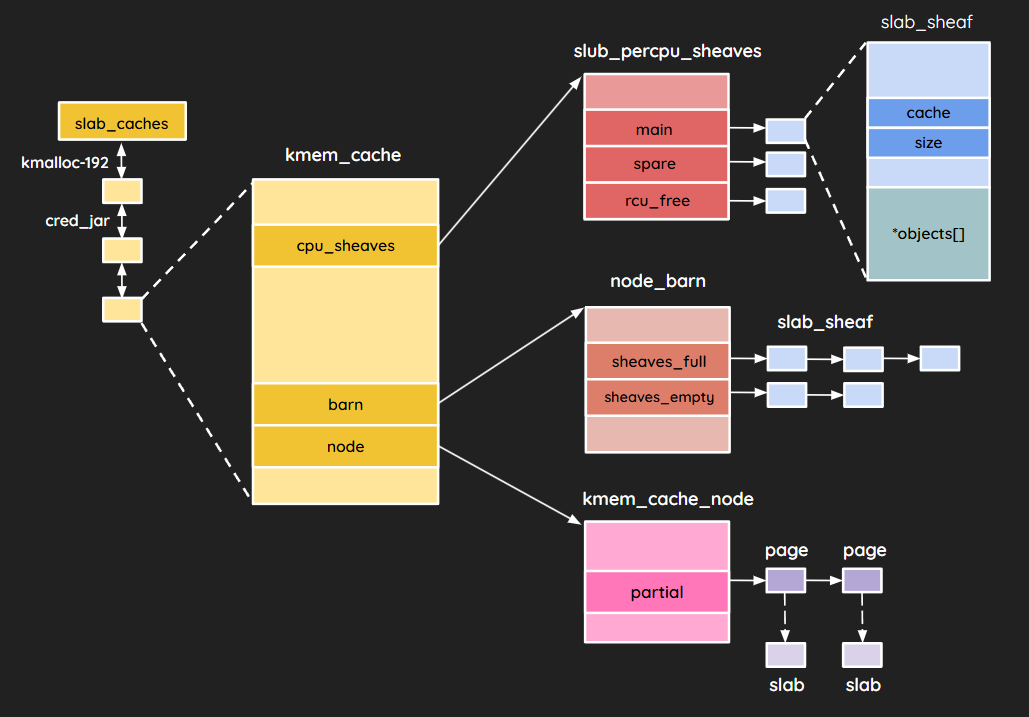
In the traditional SLUB design, a kmem_cache is managed mainly through two levels: a CPU-local cache layer (kmem_cache_cpu) and a NUMA node layer (kmem_cache_node). As core counts grew and large NUMA systems became common, the traditional per-CPU cache could still incur synchronization and management costs when many CPUs operated simultaneously. Linux 6.18 therefore introduces a new SLUB object caching mechanism that gradually replaces the local object management previously handled by kmem_cache_cpu, building a new caching layer out of sheaf and barn. The current SLUB architecture can thus be viewed as three layers that together manage kernel objects: the sheaf layer, the barn layer, and the slab management layer (kmem_cache_node).

1.2.1 Layer 1: the sheaf layer (slub_percpu_sheaves)
This layer is composed of three slab_sheaf slots: main, spare, and rcu_free. main is the sheaf currently in use, and any object to be allocated or freed is taken from this layer’s main slot. spare serves as a backup and is used as a replacement when the main slot has no object left to hand out or no room to store one. rcu_free is used for batch processing of RCU objects after kfree_rcu.
1 | // https://elixir.bootlin.com/linux/v7.1.4/source/mm/slub.c#L420 |
1.2.2 Layer 2: the barn layer (node_barn)
This layer keeps completely empty or completely full sheaves as reserves, which are shared within the same NUMA node. When the per-CPU sheaves are exhausted, a spinlock is acquired, and the sheaves in the barn are swapped with those in the per-CPU layer. The upper limits on the sheaves stored in the barn are MAX_FULL_SHEAVES and MAX_EMPTY_SHEAVES respectively, constants that will be referenced again during exploitation.
1 | // https://elixir.bootlin.com/linux/v7.1.4/source/mm/slub.c#L396 |
1.2.3 Layer 3: the slab management layer (kmem_cache_node)
kmem_cache_node, the NUMA node layer, manages slab state at the NUMA node level, handles memory reclamation and balancing across CPUs or nodes, and maintains the complete list of all slabs on that node, including partial, full, and empty slabs.
2. Vulnerability 1: Race Condition Between CQ/SQ Resize and Deferred Task Work
2.1 Root Cause
The vulnerability can be triggered through the io_uring_register syscall. When the opcode is set to IORING_REGISTER_RESIZE_RINGS, the request is forwarded to io_register_resize_rings().
1 | // https://elixir.bootlin.com/linux/v6.19.3/source/io_uring/register.c#L805 |
IORING_REGISTER_RESIZE_RINGS allows a process to expand or shrink the SQ/CQ ring of an existing io_uring instance without recreating the entire io_uring. io_register_resize_rings() first acquires ctx->mmap_lock and ctx->completion_lock, then temporarily sets the rings pointed to by the io_ring_ctx of the I/O request to NULL. After the new ring memory is allocated, the newly allocated address is written back into the io_ring_ctx.
1 | // https://elixir.bootlin.com/linux/v6.19.3/source/io_uring/register.c#L489 |
Another component that interacts with this feature and causes the vulnerability is IORING_SETUP_DEFER_TASKRUN. By default, io_uring processes all outstanding work at the end of any system call or thread interrupt, which can delay the application’s further progress. Setting this flag hints to io_uring that it should defer work until an io_uring_enter call with the IORING_ENTER_GETEVENTS flag set.
These deferred tasks are first placed into the task work queue. When new task work is added, the kernel needs to set IORING_SQ_TASKRUN to notify userspace that there are pending tasks that need to be processed. However, when updating the corresponding flags in io_ring_ctx, the operation does not acquire the same lock used by the resize functionality, resulting in a race condition.
1 | // https://elixir.bootlin.com/linux/v6.19.3/source/io_uring/io_uring.c#L1258 |
2.2 Proof of Concept
First, create an io_uring instance using IORING_SETUP_DEFER_TASKRUN and mmap the io_uring ring into userspace. Then create a timerfd that triggers at 100-microsecond intervals, and submit a multishot IORING_OP_POLL_ADD request to monitor the timerfd for the POLLIN event. Each time the timer expires, the kernel generates a poll completion. In DEFER_TASKRUN mode, these completions are deferred through task work, causing the kernel to repeatedly execute io_req_local_work_add() and set the IORING_SQ_TASKRUN flag.
In the main loop that triggers the race condition, each iteration first invokes io_uring_enter(GETEVENTS), allowing the kernel to execute the currently accumulated task work. It then calls IORING_REGISTER_RESIZE_RINGS to reconfigure the current SQ/CQ rings. If, at some point, the task work is about to modify sq_flags through ctx->rings while another CPU is concurrently performing a ring resize operation — or if the execution flow is preempted by a ring resize task during the critical timing window — the race condition may cause the ring structure referenced by ctx->rings to become invalid, ultimately resulting in a null pointer dereference.
Disclosure Timeline
- 2026-03-07: Vulnerability discovered
- 2026-03-09: Reported upstream together with a proposed patch
- 2026-03-17: Patch merged and released
Artifacts
- Patch: https://git.kernel.org/pub/scm/linux/kernel/git/stable/stable-queue.git/diff/queue-6.18/io_uring-ensure-ctx-rings-is-stable-for-task-work-flags-manipulation.patch?id=511c1f4e8933744a6e7475c5defaad673093215b
- Exploit: https://hackmd.io/epHcDaB_Tr6RZWmLobJY0g?view#vulnerability-1-PoC
- Demo: https://youtu.be/-vPd8k4ix4g
3. Vulnerability 2: Logic Error in the Error-Handling Path of the Provided-Buffer Bundle Expansion Flow
3.1 Root Cause
The vulnerability appears on the handling path of IORING_OP_SEND, the asynchronous socket send operation provided by io_uring for submitting a socket data transmission request. When a user submits this operation through io_uring, the kernel enters the io_send function to process the request.
When the request adopts the buffer selection mechanism, the handling flow enters the buffer selection path of send. At this point, the kernel builds the buf_sel_arg and selects a suitable buffer from the registered buffer pool through io_buffers_select() to serve as the data source for the subsequent send operation.
1 | // https://elixir.bootlin.com/linux/v7.2-rc1/source/io_uring/net.c#L620 |
At this time, an iovec pointer is copied from kmsg into arg.iovs and then passed as an argument to io_buffers_select(). io_buffers_select() is responsible for locating the buffer list based on buf_group. For convenience, this research chooses the provided buffer as the further analysis target.
A provided buffer allows an application to perform a receive or send without specifying a concrete memory address in each request. The kernel automatically picks free memory from a pre-registered buffer pool to hold the data, and these buffers can be registered through IORING_REGISTER_PBUF_RING.
1 | // https://elixir.bootlin.com/linux/v7.2-rc1/source/io_uring/kbuf.c#L352 |
io_ring_buffers_peek() starts from the head of the buffer ring and takes out one or more buffers in order, converting them into iovec for subsequent send/recv use. When the bundle feature is enabled, it allows multiple buffers (multiple iovec) to be selected. At this point kmsg holds an iovec array, and if that array is not large enough, it is expanded by allocating a new region with kmalloc.
1 | // https://elixir.bootlin.com/linux/v7.2-rc1/source/io_uring/kbuf.c#L287 |
Once processing finishes and returns upward, the updated iovec in arg is flushed back to kmsg so that kmsg holds the new iovec.
However, after the expansion, when each provided buffer address is checked individually, if an illegal address is found, an error is returned. This error is early-returned before the kmsg pointer is updated, so kmsg still holds the pointer to the old iovec array that has already been freed, resulting in a use-after-free.
1 | // https://elixir.bootlin.com/linux/v7.2-rc1/source/io_uring/kbuf.c#L318 |
3.2 Exploitation
In the test environment, the following protections are enabled:
- KASLR, KPTI, SMAP, SMEP
CONFIG_MEMCG_KMEMCONFIG_STATIC_USERMODEHELPERCONFIG_SLAB_FREELIST_HARDENEDCONFIG_SLAB_FREELIST_RANDOM
3.2.1 Leaking KASLR
This is a powerful primitive. The UAF structure allows the kmalloc size to be controlled, its memory pool is GFP_KERNEL, and data can be written onto the UAF structure. However, since CONFIG_MEMCG_KMEM is enabled, the target structure should avoid using a kmalloc structure with the GFP_KERNEL_ACCOUNT flag at kmalloc time when heap spraying. An alternative solution is to conduct a cross-cache attack — an innovative version of which is discussed in Sections 4 and 6.
The procedure for obtaining the UAF afterward follows the flow described below, except that the initial iovec size needs to be adjusted according to the size of the structure to be reclaimed.
First, add a key to pre-allocate user_key_payload, and create a socketpair in advance for later io_uring use. Then create a uring and map the CQ and SQ.
- First sending: A provided buffer is created and registered to the uring. At this stage, 4 provided buffers are created, with 4
ioveccoming from kmalloc-64. An SQE is then set up to send the data inside the provided buffer. WhenIOSQE_BUFFER_SELECTis specified, an I/O buffer is selected from the provided buffers as the request for the socket to read or receive data, andIORING_RECVSEND_BUNDLEmust also be specified here. With this, the send operation tries to fill multiple buffers at once rather than selecting only a single buffer to transmit, which is what makes theiovecexpansion reachable. Once the SQE is set up, the first send can be issued, andkmsgnow holds theiovecarray of 4 entries. - Second sending: Next, 8 provided buffers are set up again, at index 4 to 11. One of these provided buffer addresses is made to point to an illegal address, used to trigger an
access_okfailure, which makes the oldiovecobject held bykmsgbe freed. After theaccess_okfailure, the entire I/O request fails, and the subsequent cleanup frees theiovecagain, causing a double free. (The reason this does not trigger theCONFIG_SLAB_FREELIST_HARDENEDdouble-free detection is covered in Section 5.1.) - Third sending:
update_keyis used to reallocate the key structure, and a third send is issued to make theiovecarray overlap with theuser_key_payloadstructure.
1 | // https://elixir.bootlin.com/linux/v7.2-rc1/source/security/keys/keyctl.c#L325 |
The user_key_payload structure is shown below. datalen at offset 0x10 is metadata that controls the length of the key data, and it overlaps the low 2 bytes of the second element’s address in the iovec array. Therefore, when supplying the provided buffer, an address whose low bits are 0x1000 is mapped in advance to overwrite the key structure.
1 | // https://elixir.bootlin.com/linux/v7.2-rc1/source/include/keys/user-type.h#L27 |
Finally, reading the key back produces an out-of-bounds read that leaks KASLR.
3.2.2 Leaking the task_struct Address
The idea for privilege escalation is to leak the task_struct and overwrite its cred pointer with init_cred. Leaking the current process’s task_struct address relies on io_ring_ctx, a kmalloc-2048 sized object. When created with IORING_SETUP_SINGLE_ISSUER set, the io_uring instance is bound to the current task and can only be submitted by that single task, and the task_struct is recorded in the io_ring_ctx.
1 | // https://elixir.bootlin.com/linux/v7.2-rc1/source/io_uring/io_uring.c#L3065 |
By heap spraying this structure, and again using the same procedure as before, a user_key_payload capable of an out-of-bounds read is produced. Here, setxattr is used to overlap with the key structure from kmalloc-2048.
1 | // https://elixir.bootlin.com/linux/v7.2-rc1/source/fs/xattr.c#L645 |
In this way, the task_struct address of the current process can be leaked.
3.2.3 One-Shot cred Overwrite Leading to Local Privilege Escalation
Since the task_struct address is leaked, the next step is to write to the cred pointer of task_struct. The setup is basically the same: a kmalloc-256 double free into the sheaf is performed, and setxattr is overlapped with msg_msg, which is allocated once msgsnd is issued.
To overwrite the cred pointer in task_struct, the overlapped msg_msg is abused for arbitrary writes. Specifically, m_list.next is written as task_struct->real_cred, m_list.prev as init_cred, and security as a readable address. security must be set to a readable address because during msgrcv the SELinux hook security_msg_queue_msgrcv accesses that field.
1 | // https://elixir.bootlin.com/linux/v7.2-rc1/source/include/linux/msg.h#L9 |
When list_del is finally triggered, the cred pointer is written with init_cred, successfully completing the privilege escalation to root, as task_struct->real_cred + 8 is exactly task_struct->cred.
1 | // https://elixir.bootlin.com/linux/v7.2-rc1/source/ipc/msg.c#L1163 |
Disclosure Timeline
- 2026-07-03: Vulnerability discovered
- 2026-07-06: Reported upstream together with a proposed patch
- 2026-07-12: Patch merged and released
Artifacts
- Patch: https://git.kernel.org/pub/scm/linux/kernel/git/axboe/linux.git/commit/?h=io_uring-7.2&id=cd053d788c3f13b3eaf16672d427ee828fda16ed
- Exploit: https://hackmd.io/epHcDaB_Tr6RZWmLobJY0g?view#vulnerability-2-exploit
- Demo: https://youtu.be/xp5Qc041YCY
4. The Impact of Sheaf on Traditional Exploitation and the Solutions
As mentioned in Section 3.2.1, the mechanism of the SLUB allocator has changed significantly since Linux kernel 6.18, due to the sheaf/barn cache layer described in Section 1.2, which causes the traditional cross-cache method to fail. This section analyzes the cause, proposes two solutions to the impact of sheaf on prior SLUB techniques, and presents one approach that can bypass the sheaf cache entirely and exploit the old slab layer directly.
4.1 The Impact of the Sheaf Mechanism
In traditional cross-cache techniques, a large number of freed slabs are produced, including the ones holding UAF objects, to exhaust the partial slab space of the corresponding kmem_cache. This makes the buddy system reclaim the page so that the page of the UAF object is allocated by another cache, and the UAF structure ends up overlapping with a structure from a different kmem_cache.
However, sheaf directly affects the reclamation flow of a slab page. When an object in a slab is cached by sheaf, even though the object has been logically freed, it is still regarded as an object in use from the slab’s point of view. This prevents the slab holding the UAF object from entering the expected reclamation state, so the corresponding page cannot be reclaimed by the buddy system and reallocated to another kmem_cache.
This is also the main reason why the traditional cross-cache method did not work while analyzing the exploitation flow of the provided buffer vulnerability in this research. Although the release of the UAF object can be triggered, the slab page it sits on can never be reclaimed by the buddy system, so it is not possible to overlay that memory region by allocating objects through another kmem_cache, and the intended cross-cache attack cannot succeed.
4.2 Solution 1: Flushing Sheaf and Barn Objects Back to the Slab Management Layer
The first solution adds an extra step during cross-cache. The poisoned sheaf is first swapped from the per-CPU layer into the barn, and once the full sheaves or empty sheaves in the barn reach MAX_FULL_SHEAVES or MAX_EMPTY_SHEAVES, they are flushed back into the slab.
1 | // https://elixir.bootlin.com/linux/v7.1.4/source/mm/slub.c#L393 |
__kmem_cache_free_bulk() eventually reaches __slab_free() and returns the object back into the slab. Only then does slab->inuse drop, allowing the buddy system to reclaim the slab’s pages.
1 | // https://elixir.bootlin.com/linux/v7.1.4/source/mm/slub.c#L2914 |
In practice, the step to take is to first allocate far more than sheaf_capacity * (MAX_FULL_SHEAVES + 1) objects of the same cache, then free them all at once, after which the cross-cache attack can proceed through the normal flow.
4.3 Solution 2: Bypassing the Sheaf Cache Layer via Cross-NUMA Node Allocation
Another method is proposed here that can bypass the sheaf caching mechanism entirely and exploit the original slab mechanism directly. After an object is freed, in the free fast path, can_free_to_pcs decides whether the object can be cached by sheaf. If it cannot be cached, it falls back through __slab_free to the traditional allocation and reclamation mechanism.
1 | // https://elixir.bootlin.com/linux/v7.1.4/source/mm/slub.c#L6246 |
In the original design, the sheaf mechanism would cache objects from a remote NUMA node, but caching objects from a remote NUMA node lowers the chance of hitting the local NUMA node on later allocations, which increases overhead. For this reason, an object from a remote NUMA node is put directly back into its original slab.
1 | // https://elixir.bootlin.com/linux/v7.1.4/source/mm/slub.c#L6002 |
This can therefore be used when two NUMA nodes are present in the environment. If an object is allocated on the first NUMA node but freed on the second, the NUMA node of the sheaf cache layer differs from the NUMA node the object sits on, so it does not enter the sheaf mechanism but falls back to __slab_free to free the object at the third layer. This makes it easy to bypass the sheaf mechanism and carry out the cross-cache flow.
5. Sheaf Design Flaws: Inconsistency Between the Sheaf and Traditional Slab Implementations
As described in Section 3.2.1, the exploitation of the provided buffer vulnerability takes advantage of a design flaw in sheaf so that the double-free detection of CONFIG_SLAB_FREELIST_HARDENED is not triggered. Starting from this flaw, this section systematically examines how the original slab freelist’s CONFIG_SLAB_FREELIST_HARDENED mitigation was not accounted for during development, and how its two protections — double-free detection and pointer protection — are thereby rendered ineffective.
5.1 Flaw 1: Bypassing CONFIG_SLAB_FREELIST_HARDENED Double-Free Detection
In the traditional SLUB allocator, after an object is freed, its freelist pointer is updated through set_freepointer(). Before setting the next free object, SLUB checks whether the current object points to itself, in order to detect a double free.
1 | // https://elixir.bootlin.com/linux/v7.1.4/source/mm/slub.c#L541 |
However, when storing a newly freed object, sheaf does not use set_freepointer(). As a result, when the same object is freed repeatedly, sheaf can store the duplicate object reference directly, and during a later allocation two structures may end up sharing the same block of memory. In addition, since the sheaf cache sits before the SLUB freelist, objects are managed by sheaf first, which lets an attacker build a usable double-free primitive without triggering the SLUB freelist double-free protection.
5.2 Flaw 2: Bypassing CONFIG_SLAB_FREELIST_HARDENED Pointer Protection
Besides double-free detection, CONFIG_SLAB_FREELIST_HARDENED also provides freelist pointer protection, which prevents an attacker from directly modifying the next object pointer stored in the freelist. In the traditional SLUB, the next pointer of a free object is not stored in plaintext but encoded through freelist_ptr_encode(), which xors the next pointer with s->random, a random value generated when each kmem_cache is initialized.
1 | // https://elixir.bootlin.com/linux/v7.1.4/source/mm/slub.c#L504 |
After the sheaf caching layer is introduced, a freed object first enters the object array managed by slab_sheaf. However, the sheaf object pointer is not encrypted. This renders the existing protection ineffective and lets an attacker easily hijack the pointer, thereby controlling the memory location allocated by the kmem_cache. How this flaw is exploited is described in detail in Section 6.
6. Novel Techniques: Sheaf-Based Exploitation
Building on the sheaf-related parts of the vulnerability in Section 3, this research proposes additional privilege escalation paths and reduces the impact of the sheaf/barn mechanism on prior SLUB exploitation techniques. This section proposes three novel exploitation techniques.
Existing online discussions and articles on sheaf-related exploitation, as of July 2026, remain fairly limited. The most representative is SheafJack, a writeup by an Indonesian researcher that likewise focuses on the attack surface introduced by the sheaf mechanism and is one of the few pieces of prior work that publicly discuss this topic. However, the direction it proposes is vague in many details and contains incorrect descriptions. Taking its description of attack vector 2 as an example, it mentions triggering the cross-cache flow through refill_sheaf, but reviewing the actual source code shows that no such behavior exists. This section provides a more detailed and concrete explanation of sheaf-based exploitation and presents new exploitation techniques.
6.1 Technique 1: Object Array Hijack
slab_sheaf is an object pointer array (see Section 1.2). When an object is freed, the main sheaf is taken from the current slub_percpu_sheaves, the object is stored into that structure, and size is updated.
1 | // https://elixir.bootlin.com/linux/v7.1.4/source/mm/slub.c#L5806 |
Conversely, when the kernel tries to allocate a block of memory, it also attempts to obtain an object from the main sheaf.
1 | // https://elixir.bootlin.com/linux/v7.1.4/source/mm/slub.c#L4707 |
If the object array pointer in slab_sheaf can be overwritten, the memory allocated by SLUB can be hijacked to any desired location for later exploitation. The slab_sheaf structure is shown below.
1 | // https://elixir.bootlin.com/linux/v7.1.4/source/mm/slub.c#L404 |
The object array in this structure is a variable-length array of pointers. Every kmem_cache has its own sheaf layer, and which kmem_cache a slab_sheaf is allocated from depends on the size of the object it manages, as shown below. Note that the actual capacity is obtained by taking the maximum of the value below and the capacity specified when each kmem_cache is initialized.
s->size |
Capacity | Backing kmalloc cache |
|---|---|---|
| < 256 | 60 | kmalloc-512 |
| ≥ 256 and < 1024 | 26 | kmalloc-256 |
≥ 1024 and < PAGE_SIZE |
12 | kmalloc-128 |
≥ PAGE_SIZE |
4 | kmalloc-64 |
1 | // https://elixir.bootlin.com/linux/v7.1.4/source/mm/slub.c#L7741 |
Therefore, by allocating or freeing large numbers of the objects managed by slab_sheaf, objects in the four buckets kmalloc-64, kmalloc-128, kmalloc-256, and kmalloc-512 can be heap sprayed, and a UAF can ultimately be used to hijack the object array to achieve arbitrary read and write.

The actual procedure is as follows. The goal is to reclaim the UAF object by heap spraying slab_sheaf. Here, a kmalloc-512 UAF is assumed to be available, and maple tree nodes can be chosen for the heap spray. Each time a new region is mmap’d, a new VMA is allocated, and a new maple node is allocated from maple_node_cache.
1 | // https://elixir.bootlin.com/linux/v7.1.4/source/lib/maple_tree.c#L1089 |
This kmem_cache specifies a capacity of 32 at initialization, so its slab_sheaf is allocated from kmalloc-512.
1 | // https://elixir.bootlin.com/linux/v7.1.4/source/lib/maple_tree.c#L5630 |
To heap spray slab_sheaf, the slab_sheaf instances in the barn and in slub_percpu_sheaves are first exhausted through mass allocation and freeing. Then, when allocating a new object, because all slab_sheaf instances are out of objects, the kernel will try to allocate a new slab_sheaf.
1 | // https://elixir.bootlin.com/linux/v7.1.4/source/mm/slub.c#L4649 |
After that, the UAF is used to overwrite the object array with modprobe_path or any other target location. Privilege escalation is then achieved by making the allocator return memory at a target such as modprobe_path and performing an arbitrary read and write there.
To simplify the verification process, Technique 1 and Technique 2 were verified using a custom kernel driver that contains a UAF, available at: https://hackmd.io/epHcDaB_Tr6RZWmLobJY0g?view#technique-1-and-2-test-kernel-driver
Artifacts
- Exploit: https://hackmd.io/epHcDaB_Tr6RZWmLobJY0g?view#technique-1-exploit
- Demo: https://youtu.be/pgtzXYAjxO8
6.2 Technique 2: Object Array Out-of-Bounds Write
An arbitrary write of sufficient length is not always available, or the UAF write primitive on the object may be incomplete, so overwriting the object array can easily lead to a kernel panic. Two additional methods are provided here to escalate privileges without controlling the object array — the first below, and the second in Section 6.3. The following is the behavior when freeing an object:
1 | // https://elixir.bootlin.com/linux/v7.1.4/source/mm/slub.c#L5806 |
It can be observed that when the size field of the current main sheaf equals capacity, the sheaf is treated as a full sheaf that can take no more objects, so the main sheaf is swapped with another sheaf. However, if the size field of slab_sheaf can be controlled to exceed capacity, no check is performed, and the next time an object is freed, its object pointer is written to an arbitrary location. This yields a single arbitrary pointer write.

The exploit procedure is as follows. First, two cred structures with root privileges are loaded into memory in advance. The usage field is set to a large value to prevent the structures from being accidentally reclaimed during later exploitation.
Next, slab_sheaf and task_struct are heap sprayed in an interleaved manner. task_struct is sprayed through fork, and each subprocess repeatedly checks its own uid.
Through corrupting the size field, the offset of the next write is changed to the task_struct->real_cred field. The pre-arranged structures are then freed. On the first free, the object is placed at objects[size] through free_to_pcs to overwrite the real_cred pointer. On the second free, it is placed at objects[size+1] to overwrite the cred pointer. After the out-of-bounds operation, size is restored to its original position to prevent a kernel panic during subsequent frees.
When a looping subprocess finds that its own uid has become 0 (root), a root shell can be opened, completing the privilege escalation.
Artifacts
- Exploit: https://hackmd.io/epHcDaB_Tr6RZWmLobJY0g?view#technique-2-exploit
- Demo: https://youtu.be/K4ZJ_W5pkfE
6.3 Technique 3: Cross-Cache via the RCU slab_sheaf
This section proposes a novel technique that resolves the following three problems of traditional cross-cache:
- Traditional cross-cache requires mass frees to fill the SLUB partial freelist and have it reclaimed into the buddy system, and there is no precise way to know whether the page holding the UAF object has already been reclaimed.
- The operating system carries a lot of noise, so the page holding the reclaimed UAF object is very likely to be allocated by another
kmem_cache, causing the exploitation to fail. - When the buddy system finds that adjacent pages are all reclaimed, they are merged into a larger
free_area, making the corresponding page difficult to obtain.
This section presents a new technique that can precisely steer a UAF object into a kmem_cache of any size and type, and that can escalate privileges under more constrained environments or primitives.
Besides main and spare, slab_sheaf also has an rcu slot. After an object is freed through kfree_rcu, the rcu sheaf stores the freed object until the grace period ends, at which point the whole batch of objects is flushed into the barn. If the barn reaches its limit, the objects are flushed directly back into the slab of the corresponding kmem_cache.
1 | // https://elixir.bootlin.com/linux/v7.1.4/source/mm/slab_common.c#L1957 |
Through the rcu sheaf, an RCU callback does not have to be created for every object, and a large number of RCU objects can be processed in batch. The callback function rcu_free_sheaf registered by call_rcu is then invoked after the grace period ends, and it begins cleaning up the objects in the rcu sheaf.
1 | // https://elixir.bootlin.com/linux/v7.1.4/source/mm/slub.c#L5974 |
Which barn an object is placed into, or which kmem_cache structure it is flushed back to, is looked up according to the cache field of the rcu slab_sheaf itself, and which kmem_cache‘s barn is used is also determined by that field.
1 | static void rcu_free_sheaf(struct rcu_head *head) |
With a UAF primitive available, hijacking the cache field allows a large heap spray of RCU to flush the UAF object into an arbitrary kmem_cache during the RCU callback.
This technique is a new cross-cache path. It does not rely on the traditional route of going through the buddy system to cross a UAF object into another memory pool, reducing the uncertainty caused by internal state changes in the buddy system, and making the overall attack flow more stable. In addition, this method does not require the complex free procedure described in Section 4.2, nor the NUMA-node-dependent operations described in Section 4.3, which simplifies the overall execution flow and improves the portability of the technique.

6.4 Applying Technique 3 to Vulnerability 2
This section applies the proposed Technique 3 to the provided buffer vulnerability found in this research, offering a new privilege escalation path.
6.4.1 Triple Free for Information Leak and Overlapping the RCU slab_sheaf
The goal is to corrupt an object managed by kmalloc-192, whose slab_sheaf comes from kmalloc-512, so many of the following operations take place across these two kmem_cache.
First, in addition to pre-allocating user_key_payload and later allocating it via update key, a large number of IPv6 multicast sockets are also created in advance for the subsequent heap spray of the RCU slab_sheaf.
Then, the vulnerability is triggered as before, but this time a double free is performed twice, producing three pointers on the sheaf that point to the same location for later use.
After that, user_key_payload allocated from kmalloc-512 overlaps with the iovec structure, overwriting datalen and causing an out-of-bounds read. This out-of-bounds read is mainly used to observe the sheaf state and leak the cred_jar address, while the third pointer is left for later use by a newly allocated sheaf.
A large number of kmalloc-192 objects are then allocated and freed, in order to exhaust the free sheaves in the main and barn of the corresponding kmem_cache. This forces alloc_empty_sheaf to request new memory for the rcu slab_sheaf when a kmalloc-192 object is RCU freed and placed into it, and that new sheaf takes the third pointer produced above, overlapping the iovec with the user_key_payload. Whether the occupation succeeds is determined by the READ_LEN returned when user_key_payload is read, since that value is shrunk by the allocated slab_sheaf.
As mentioned earlier, the heap spray of the rcu sheaf slab is done through IPv6 multicast sockets. MCAST_MSFILTER is the API used to filter multicast sources. To support switching the multicast source filter from the old version to the new version safely, RCU is invoked, and kfree_rcu is called in the end.
1 | // https://elixir.bootlin.com/linux/v7.1.4/source/net/ipv6/mcast.c#L574 |
6.4.2 Leaking the cred kmem_cache Address
The iovec is then updated again to restore datalen and regain the information leak. cred is heap sprayed and freed through fork subprocesses to force the allocation of a slab_sheaf from the cred kmem_cache, so that slab_sheaf->cache appears in memory. The address of that structure and its fields appear near user_key_payload, and the location of cred_jar can be leaked through the information leak. Although cred is also kmalloc-192 in size, it is a kmem_cache independent of the general cache pool, so it does not affect the state produced earlier.
1 | // https://elixir.bootlin.com/linux/v7.1.4/source/kernel/cred.c#L36 |
6.4.3 Privilege Escalation by Poisoning the RCU Cache and Cross-Cache Attacking cred_jar
A UAF object is then produced again through the earlier method. One object is an iovec used to write to the object, and another uses an IPv6 multicast socket so ip6_sf_socklist can take the other copy. After RCU ends, the UAF object is placed into the RCU slab_sheaf that was overlapped with the other objects earlier.
Next, the RCU slab_sheaf->cache is written to change it to cred_jar.
A large heap spray is then performed so that ip6_sf_socklist fills the RCU slab_sheaf. Once it becomes a full sheaf, the slab_sheaf is swapped into the barn. Because its owning cache has been corrupted, it is placed into the barn of cred. The UAF object is thereby cross-cached into another kmem_cache.
Finally, through a large number of fork subprocesses, an attempt is made to obtain the UAF object that has entered cred_jar, and the UAF object is actively written through the iovec. Each subprocess then keeps checking in a loop whether its uid or gid has been overwritten, and privilege escalation is ultimately achieved.
Artifacts
- Exploit: https://hackmd.io/epHcDaB_Tr6RZWmLobJY0g?view#vulnerability-2-exploit-via-technique-3
- Demo: https://youtu.be/9xl1PZMr06k
7. Conclusion
This research first discovers two 0-days in the io_uring subsystem. Both vulnerabilities have already been reported to upstream, fixed, and patched.
- The first vulnerability lies between the CQ/SQ ring resize feature and the deferred task work mechanism. During ring resize, the update to
ctx->ringsand the task work operation that modifies the ring flag do not hold the proper lock and therefore lack adequate synchronization, which creates a race condition that an attacker can exploit to cause a null pointer dereference. - The second vulnerability lies in the error-handling flow of the provided-buffer bundle feature. After the kernel tries to expand the
iovecarray, an error occurs and the path rolls back when a provided buffer contains an illegal address. On the rollback path, theiovecpointer inkmsgitself is not updated correctly, leading to a UAF. This research further builds a complete exploit chain for this vulnerability and achieves local privilege escalation in an environment with multiple modern Linux kernel protections enabled.
However, during exploit development, this research finds that the SLUB sheaf/barn mechanism introduced after Linux kernel 6.18, which adds two cache layers targeting per-CPU and NUMA on top of the original slab mechanism, significantly changes the object management flow of the traditional SLUB allocator. Techniques widely used in past kernel exploitation are invalid once sheaf is introduced: a freed object may remain in the new caching layer for a long time, so the object is marked as still in use by the slab itself and cannot be reclaimed by the buddy system. Two solutions are therefore proposed:
- More objects are heap sprayed to swap large numbers of per-CPU sheaves into the barn. Once the full sheaves or empty sheaves in the barn reach their limit, they are flushed into the slab, and the original cross-cache can finally be carried out this way.
- In an environment with multiple NUMA nodes, memory can be allocated by binding the current process to one NUMA node while freeing on another. Since caching objects from a different NUMA node in the sheaf layer would lower the chance of hitting the local NUMA node later and cause a performance problem, sheaf does not cache objects from a remote NUMA node, and this allows the original slab mechanism to be exploited directly.
In addition, a deeper study of the sheaf/barn mechanism reveals that its design renders the original SLUB SLAB_FREELIST_HARDENED mitigation almost completely ineffective. This mitigation mainly provides the following two protections:
- Double-free check: when an object is linked into the freelist, whether the object being linked already exists in the freelist is checked, in order to detect repeated frees. On the sheaf fast path, however, this check is never used, and under normal conditions an object is cached by sheaf/barn first, so a simple double free of the same object into the sheaf makes later exploitation easy.
- Pointer protection: the freelist is a linked list in which each freed object points to the next through a pointer, and this protection encodes the pointer by xoring it with a random value generated when the
kmem_cacheis created. In the sheaf mechanism, however,slab_sheafuses an object pointer array to manage the objects stored in it, and on free or allocation, an object is obtained according to the number of objects the current sheaf holds (size). The object pointer array is not protected by pointer encryption, so a simple heap spray ofslab_sheafand tampering with the object array pointer makes it easy to hijack object allocation and freeing.
Beyond that, introducing sheaf/barn does not only bring inconvenience to SLUB exploitation. On the contrary, this mechanism actually offers a larger attack surface, and building on it, three new sheaf-based exploitation techniques are developed:
- Object array hijack: this exploits the fact that
slab_sheaf->objects[]is not covered by pointer protection to directly control the SLUB allocator into returning an object at an arbitrary location. - Object array OOB write: this uses controllable sheaf metadata, such as the
sizefield, to cause an out-of-bounds write on the object pointer array. Heap grooming arrangestask_structandslab_sheafinto a specific layout in memory, and tampering withsizethen achieves a single arbitrary pointer write. The memory that this pointer refers to is filled with a root-privilegedcred, and the arbitrary pointer write is used to overwritetask_struct->credfor privilege escalation. - Cross-cache by RCU sheaf: traditional cross-cache relies on the buddy system to reclaim a useless page (slab) once the partial freelist reaches its limit, thereby moving a UAF object into another
kmem_cache. This technique instead makes use of how RCU accumulates rcu objects into aslab_sheafduring a grace period and creates a callback for multiple objects at once. After the grace period ends, the objects stored in theslab_sheafare flushed back into the barn or the slab.slab_sheaf->cacherecords which cache the stored objects come from, and hijacking this metadata makes it possible to place objects into any cache pool more flexibly and stably. Compared with traditional cross-cache, this method does not depend on the buddy system reclaiming pages, avoiding the uncertainty caused by the buddy system’s internal state and by differentkmem_cachecontending for pages.
Finally, based on the new cross-cache technique proposed above, a new exploit chain is built for the second vulnerability.
In summary, this research not only presents two new memory safety vulnerabilities in the io_uring subsystem but also builds a complete privilege escalation path on one of them. This also serves as the starting point for an in-depth study of how the new SLUB sheaf/barn allocator affects existing kernel exploitation techniques, along with the corresponding solutions. Going further, this research analyzes the sheaf/barn mechanism as a new attack surface, first showing how its design flaws render the original SLUB mitigation ineffective, and then proposing three new exploitation techniques based on the mechanism. Among them, the RCU sheaf-based cross-cache technique breaks the traditional cross-cache attack’s dependence on buddy system page reclaim, allowing an attacker to steer objects between different cache pools more flexibly and stably. This research is intended to provide a new direction and attack surface for future work on Linux kernel exploitation.
after all
I hope you enjoyed this research. I believe there are still many aspects worth further study. If you found any mistake and want to discuss with me, please cotact with my discord (naup_sumire_hime) or my gmail (naup96721@gmail.com).
References
- Game of Cross-Cache — https://i.blackhat.com/Asia-24/Presentations/Asia-24-Wu-Game-of-Cross-Cache.pdf
- USENIX Security ‘23 prepub — https://www.usenix.org/system/files/sec23summer_79-lee-prepub.pdf
- linux-kernel mailing list, sheaf discussion — https://lists.openwall.net/linux-kernel/2025/09/10/485
io_uring_enter(2)man page — https://man7.org/linux/man-pages/man2/io_uring_enter.2.html- SheafJack: Advanced Kernel Exploitation in Linux 6.18 via slab_sheaf Hijack — https://www.slideshare.net/slideshow/sheafjack-advanced-kernel-exploitation-in-linux-6-18-via-slab_sheaf-hijack/287245786
- SYSTOR ‘22, APIs paper — https://atlarge-research.com/pdfs/2022-systor-apis.pdf
- FOSDEM 2026, SLUB Sheaves Update — https://fosdem.org/2026/events/attachments/DPXVYJ-slub-sheaves-update/slides/267397/fosdem-sh_pvi6fpf.pdf
- maple-tree mailing list — https://lists.infradead.org/pipermail/maple-tree/2025-August/004477.html
- “sheaves for all” patch series (v2) — https://patchew.org/linux/20260112-sheaves-for-all-v2-0-98225cfb50cf@suse.cz/20260112-sheaves-for-all-v2-14-98225cfb50cf@suse.cz/
- Black Hat USA ‘22 — A New Exploitation Method — https://i.blackhat.com/USA-22/Thursday/US-22-Lin-Cautious-A-New-Exploitation-Method.pdf